Drought Management Plan 2027 Consultation

Our Drought Plan outlines the way we would respond in a drought situation and the actions we would take as it progresses. This plan, if put into action, has the potential to impact the way our customers use water. We operate in a dry and densely populated area of the country and are at risk of experiencing droughts. Our aim is to ensure we are better prepared for these events than ever before.

We are not starting from scratch, this plan is based on our previous experience of drought events and how we have managed them, as well as experience from across the water industry. We have adopted a different approach to this draft Drought Plan which signals a greater focus on the actions we will take in a severe drought event. This is primarily an operational plan in remit, but it also articulates the vital importance of early communication to increase awareness of the indicators of environmental stress that tell us a drought may be near. Droughts are complex and their impacts and risks can be difficult to mitigate – we are committed to working collaboratively with our communities to increase understanding and to minimise impacts on the environment.

Our Drought Plan includes the actions we would take to manage the effects of drought on our water supplies. These include demand management actions, where we would ask our customers to use less water. This is either voluntarily or through temporary use restrictions and depends on the severity of the situation. In severe droughts, we can also apply for drought permits and orders to take more water from underground aquifers where necessary to meet customer demand and further limit what we use water for.


Consultation

We submitted our draft Plan to the Secretary of State for security review on 26th March 2026 and after receiving their approval to publish we are now in a period of public consultation for ten weeks ending 17th July 2026.

We are now inviting views from customers and stakeholders on the key elements of our plan as we need a drought plan that represents your interests, our communities and the environment. Please take a look at our non-technical summary document for a high level overview or our full Drought Plan if you would like to understand more detail.

Anyone who would like to provide feedback on our draft Drought Plan can do so by email or post or by completing the online form on this webpage.

Please note:

Representations by email should be sent to: water.resources@defra.gov.uk. Please include Affinity Water in your email subject field and copy in our consultation email address: DMPconsultation@affinitywater.co.uk.

If necessary, representations by post should be sent to:

Drought Plan Consultation

Defra

Drought

Seacole, 2 Marsham Street

London SW1P 4DF

If you would like to view hard copies of our draft drought plan documents, please let us know by emailing DMPconsultation@affinitywater.co.uk and we will arrange for these to be posted to you.

Next Steps

Once the public consultation ends and we have received all the feedback on our draft plan, we will publish a Statement of Response on our website in October 2026. This will detail each of the representations made on our Plan and explain whether we have made changes to the Plan as a result. Where we have not made changes as a result of comments, we will explain why.

Along with our Statement of Response we will submit a revised draft Drought Plan to Defra, and once we receive final approval, we will publish our new Plan on our website in Spring 2027.

Our Drought Plan outlines the way we would respond in a drought situation and the actions we would take as it progresses. This plan, if put into action, has the potential to impact the way our customers use water. We operate in a dry and densely populated area of the country and are at risk of experiencing droughts. Our aim is to ensure we are better prepared for these events than ever before.

We are not starting from scratch, this plan is based on our previous experience of drought events and how we have managed them, as well as experience from across the water industry. We have adopted a different approach to this draft Drought Plan which signals a greater focus on the actions we will take in a severe drought event. This is primarily an operational plan in remit, but it also articulates the vital importance of early communication to increase awareness of the indicators of environmental stress that tell us a drought may be near. Droughts are complex and their impacts and risks can be difficult to mitigate – we are committed to working collaboratively with our communities to increase understanding and to minimise impacts on the environment.

Our Drought Plan includes the actions we would take to manage the effects of drought on our water supplies. These include demand management actions, where we would ask our customers to use less water. This is either voluntarily or through temporary use restrictions and depends on the severity of the situation. In severe droughts, we can also apply for drought permits and orders to take more water from underground aquifers where necessary to meet customer demand and further limit what we use water for.


Consultation

We submitted our draft Plan to the Secretary of State for security review on 26th March 2026 and after receiving their approval to publish we are now in a period of public consultation for ten weeks ending 17th July 2026.

We are now inviting views from customers and stakeholders on the key elements of our plan as we need a drought plan that represents your interests, our communities and the environment. Please take a look at our non-technical summary document for a high level overview or our full Drought Plan if you would like to understand more detail.

Anyone who would like to provide feedback on our draft Drought Plan can do so by email or post or by completing the online form on this webpage.

Please note:

Representations by email should be sent to: water.resources@defra.gov.uk. Please include Affinity Water in your email subject field and copy in our consultation email address: DMPconsultation@affinitywater.co.uk.

If necessary, representations by post should be sent to:

Drought Plan Consultation

Defra

Drought

Seacole, 2 Marsham Street

London SW1P 4DF

If you would like to view hard copies of our draft drought plan documents, please let us know by emailing DMPconsultation@affinitywater.co.uk and we will arrange for these to be posted to you.

Next Steps

Once the public consultation ends and we have received all the feedback on our draft plan, we will publish a Statement of Response on our website in October 2026. This will detail each of the representations made on our Plan and explain whether we have made changes to the Plan as a result. Where we have not made changes as a result of comments, we will explain why.

Along with our Statement of Response we will submit a revised draft Drought Plan to Defra, and once we receive final approval, we will publish our new Plan on our website in Spring 2027.

  • Hear from Steve (Director of Asset Strategy and Capital Delivery) on the launch of our Drought Plan Consultation

    This new Drought Plan has been developed at a time of global climatic change, which will have implications for generations to come.

    Droughts are naturally occurring phenomena that we anticipate and diligently prepare for, aligning with our responsibility as providers of an essential public service.

    We have built upon the feedback to our last Drought Management Plan and Water Resources Management Plan consultations, to help understand what matters to you. Our new draft Drought Plan reflects the changing priorities and needs of your community, whilst minimising impact on the environment.

    You asked us to engage with you sooner during times of water shortage and to take more actions earlier, before water supplies become stretched and at points when we may start to see environmental stress. Our plan explains how we will do that.

    Written in a style that is simpler to read and easier to navigate, our hope is that more of our customers and stakeholders can access our plan and in so doing understand the actions we need to take in drought periods.

    Our Drought Plan serves as an operational guide for our people. However, it is also a commitment to our customers on how we will ensure we balance the needs of water demand and the environment during times of drought.

    I hope you will find this new Drought Plan informative and easy to read and we would welcome your feedback to our consultation to help shape and finalise our Plan.

    This new Drought Plan has been developed at a time of global climatic change, which will have implications for generations to come.

    Droughts are naturally occurring phenomena that we anticipate and diligently prepare for, aligning with our responsibility as providers of an essential public service.

    We have built upon the feedback to our last Drought Management Plan and Water Resources Management Plan consultations, to help understand what matters to you. Our new draft Drought Plan reflects the changing priorities and needs of your community, whilst minimising impact on the environment.

    You asked us to engage with you sooner during times of water shortage and to take more actions earlier, before water supplies become stretched and at points when we may start to see environmental stress. Our plan explains how we will do that.

    Written in a style that is simpler to read and easier to navigate, our hope is that more of our customers and stakeholders can access our plan and in so doing understand the actions we need to take in drought periods.

    Our Drought Plan serves as an operational guide for our people. However, it is also a commitment to our customers on how we will ensure we balance the needs of water demand and the environment during times of drought.

    I hope you will find this new Drought Plan informative and easy to read and we would welcome your feedback to our consultation to help shape and finalise our Plan.

  • Supporting our environmental ambitions
    supporting image

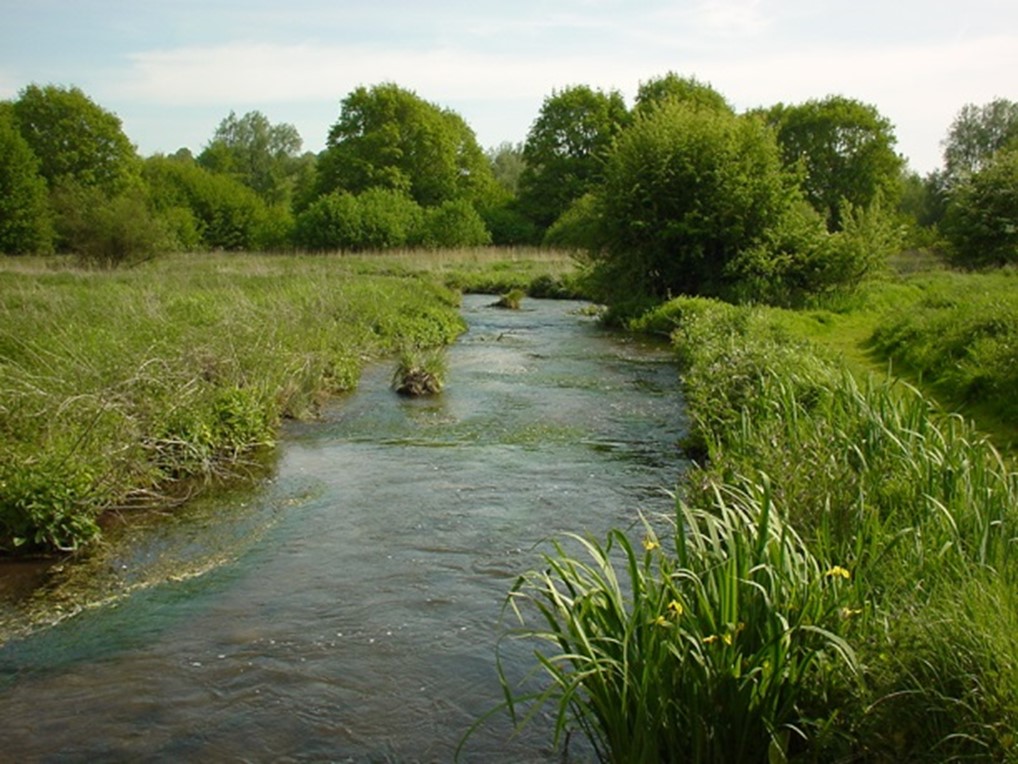
    Since 1990, we have undertaken a number of in-depth investigations on most of the chalk stream catchments within our supply areas. These have helped to improve our understanding of how these catchments function, and how they respond to factors such as droughts and changes in groundwater abstraction. We have used that knowledge to make decisions about reducing groundwater abstraction where our operations may be having an impact and going forward, we will continue this commitment. Over the next five years (2025-2030) we plan to deliver an investment programme that reduces water taken from the chalk aquifer by 35 million litres

    Since 1990, we have undertaken a number of in-depth investigations on most of the chalk stream catchments within our supply areas. These have helped to improve our understanding of how these catchments function, and how they respond to factors such as droughts and changes in groundwater abstraction. We have used that knowledge to make decisions about reducing groundwater abstraction where our operations may be having an impact and going forward, we will continue this commitment. Over the next five years (2025-2030) we plan to deliver an investment programme that reduces water taken from the chalk aquifer by 35 million litres per day, focused on the upper reaches of chalk stream catchments. Our aim is to improve the long-term resilience of these important habitats, which will help to improve their ability to recover from naturally occurring events such as droughts.

    Alongside this, we have a well-established and ambitious Environmental Enhancement Programme delivered through the Water Industry National Environment Programme which aims to deliver schemes on the ground that protect, preserve and enhance the environment through various initiatives. This includes a programme of catchment and nature-based solutions which includes river restoration projects, working in partnership with the Environment Agency and other partners. We have been delivering river restoration for over 10 years and our Asset Management Period 8 programme (2025-2030) will see projects delivered on the Rivers Ver, Lea, Mimram, Misbourne, Gade, Beane, Chess, Bulbourne, Colne, Ivel, Cam, Stort, Ash, Dour and Little Stour. We have also provided additional flow support to the Rivers Hiz, Oughton and Ivel as well as the Cam through our flow enhancement initiatives by pumping water from our boreholes into the rivers when the local environment requires it. Complementary to this, we deliver land management schemes working with landowners, businesses and farmers across our region to protect and preserve drinking water and help chalk stream catchments be more resilient to environmental pressures including pollution, flooding and drought pressures.

    Additionally, we have an extensive biodiversity programme which is protecting, creating and enhancing habitats within our own landholdings, as well as working across our supply area to manage invasive non-native species, create and restore habitats in partnership with others and preserve threatened plant, tree and wildlife species.

    Our Drought Plan supports our environmental ambitions by minimising the impacts of drought on the environment in our regions wherever possible. In line with the Environment Agency Water Company Drought Plan Guideline and the Drought Plan (England) Direction 2025, our Plan prioritises taking actions that have the least environmentally damaging impact. This includes demand management and operational actions like promoting water efficiency. In this round of planning, we have included enhanced environmental monitoring to ensure we are closely following conditions on the ground and working to mitigate the impacts of any actions we may need to take during a drought.

  • Where our water supply comes from

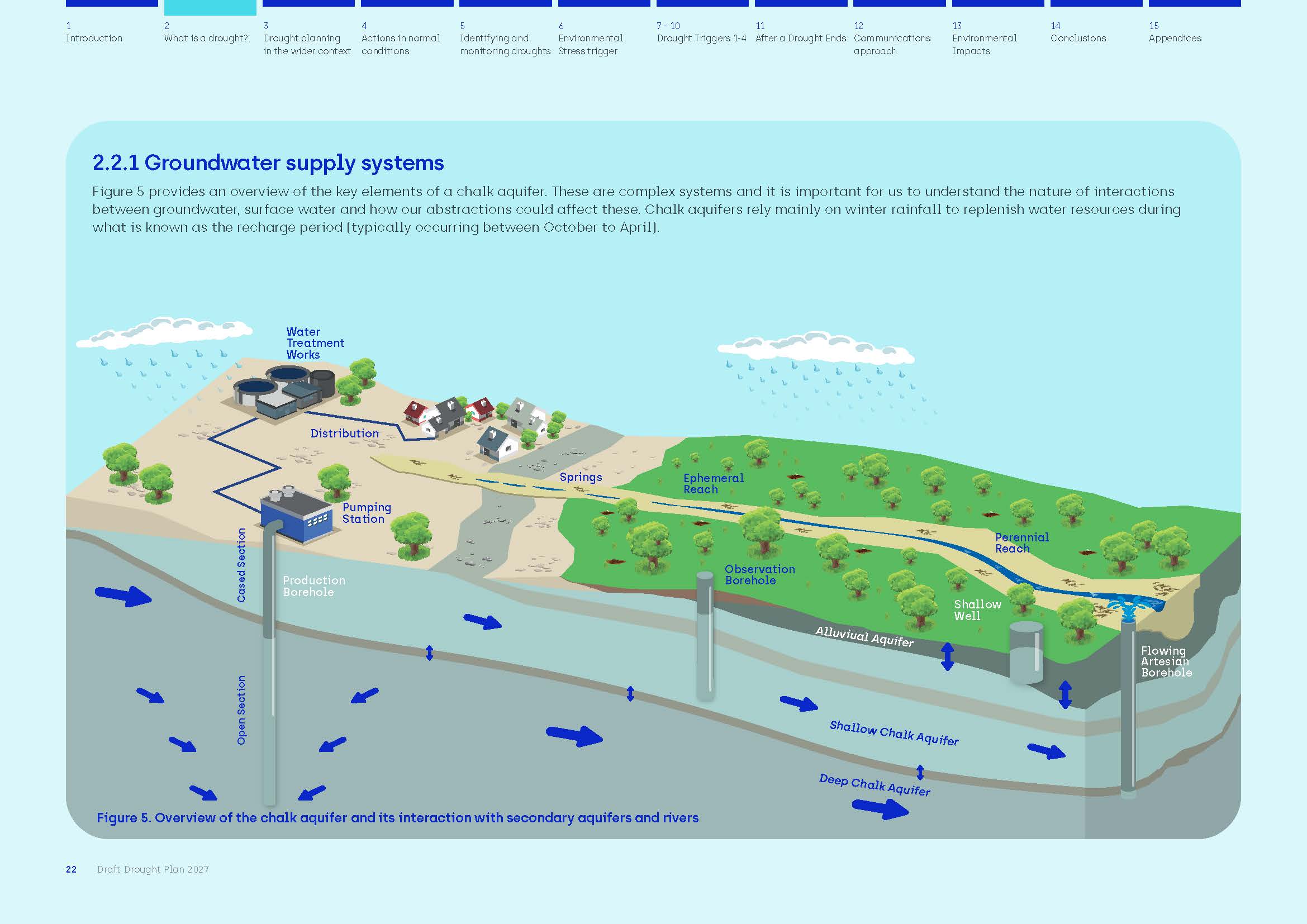
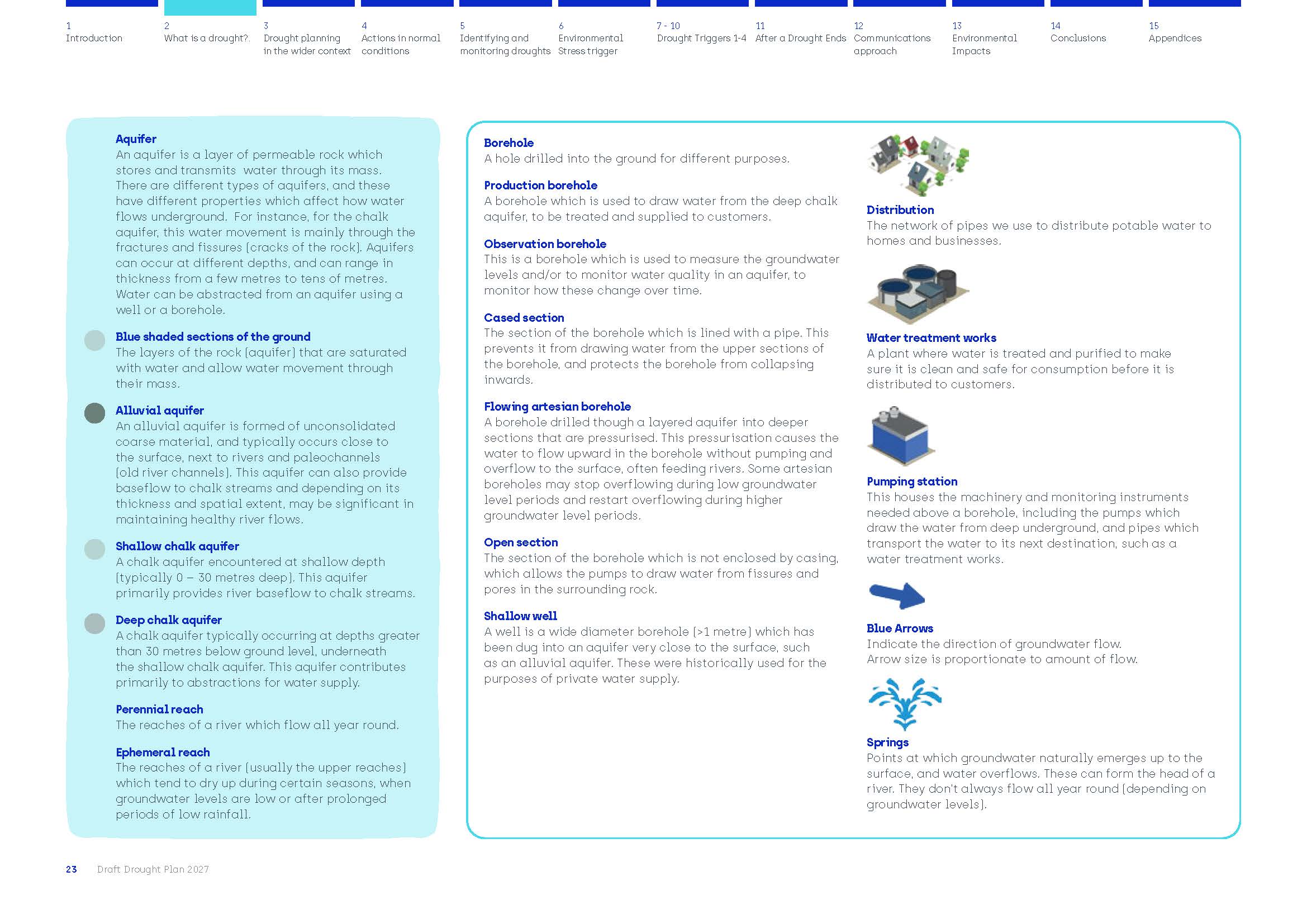
    The majority of the water we supply comes from aquifers below the ground – please see the accompanying graphic which illustrates a typical groundwater system in our area.

    Aquifers are a body of porous rock or sediment that can store water, known as groundwater. These are complex systems and it is important for us to understand the nature of interactions between groundwater, surface water (river flows and lake levels) and how our abstractions could affect these. In our supply area, the main aquifer is made of chalk which also helps feed our local rivers and globally rare chalk streams. When

    The majority of the water we supply comes from aquifers below the ground – please see the accompanying graphic which illustrates a typical groundwater system in our area.

    Aquifers are a body of porous rock or sediment that can store water, known as groundwater. These are complex systems and it is important for us to understand the nature of interactions between groundwater, surface water (river flows and lake levels) and how our abstractions could affect these. In our supply area, the main aquifer is made of chalk which also helps feed our local rivers and globally rare chalk streams. When groundwater levels are high, the rivers flow along most of its length, when groundwater levels are low, some rivers will begin to dry out, particularly in the upper reaches. This is a natural process and these parts of the river are known as winterbourne or ephemeral reaches, as they do not flow all the time.

    Groundwater levels are most strongly influenced by weather (particularly winter rainfall) and naturally vary with the seasons. However, our operations can also affect groundwater levels in some areas, which is why we pay close attention to the impact this has on the environment. We have an extensive environmental monitoring network and are investing significant amounts into improving habitats in local river systems through the Water Industry National Environment programme. This will help to improve the resilience of these habitats to drought events.

    Groundwater systems rely on winter rainfall to replenish water resources during what is known as the recharge period (typically October to April).


  • Working collaboratively across the South East

    supporting image

    The water companies of the southeast of England recognise that as an industry we need to work collaboratively to share knowledge and best practice, co-ordinate and align communication to customers and stakeholders, and promote the efficient use of water resources. Therefore, we work closely with other water companies in our region as part of the WRSE and WRE groups. This is set out in the regional groups Statement of Intents (SOI) which were updated for the draft Drought Plan 2027 submissions (sections of the WRSE SOI are included below for reference).

    We participate in the WRSE Dry Weather Working Group

    The water companies of the southeast of England recognise that as an industry we need to work collaboratively to share knowledge and best practice, co-ordinate and align communication to customers and stakeholders, and promote the efficient use of water resources. Therefore, we work closely with other water companies in our region as part of the WRSE and WRE groups. This is set out in the regional groups Statement of Intents (SOI) which were updated for the draft Drought Plan 2027 submissions (sections of the WRSE SOI are included below for reference).

    We participate in the WRSE Dry Weather Working Group (DWMG). The purpose of the group is to support close collaboration, understanding and pre-planning for drought, dry weather and high demand events, or other issues, which threaten the resilience of the supply demand position of member companies. It provides a forum for members to discuss, provide updates and share information; undertake scenario testing, to progress and improve planning for co-ordinated regional management of a developing drought. Through exception reporting, it monitors and alerts water company members when the region is operating at heightened levels of risk and advises when increasing levels of regional coordination of joint actions and preparedness is desirable, including communication with customers and the introduction of restrictions. It draws information from national, regional and local assessments and provides updates to help inform regional and national awareness and early preparedness. Under normal conditions, the DWMG meets on a bi-monthly basis and the frequency of meetings increases during dry weather and drought events.

    The basis for the variability of responses to water use restrictions from water companies in Southeast England.

    In the South East region water companies source their supplies of raw water in the following ways:

    1. River abstraction;
    2. Reservoirs filled by river abstraction or impoundment of river water;
    3. Groundwater abstraction from boreholes and springs.

    The percentage balance of these varies from company to company, and even within company areas and this causes variability in drought resilience and response.

    The impact of drought is felt in different areas and over different timescales. An agricultural drought affecting crop production and other farming practices can occur over the growing season reducing water supply and moisture in soils. In contrast, a water resources drought affecting the availability of water for potable supplies, takes much longer to develop after several months of below average rainfall. The low groundwater levels, reservoir levels and river flows that result from this type of dry period cause challenges in a water company’s ability to maintain a secure supply of water to customers.

    To manage this risk, water use restrictions are an important measure that water companies can use to reduce demand during drought. They not only enable companies to maintain essential supplies but also help to reduce the environmental impacts of abstraction during this critical period.

    Water companies will only impose water use restrictions upon their customers if they are absolutely necessary and in accordance with their Levels of Service for water supply. Water companies fully appreciate the confusion that can be caused when one company introduces restrictions, but a neighbouring company does not. One of the reasons for this is the geographical extent of the drought: it may be very localised and not extend beyond the area served by an individual water company.

    The reasons why companies may have to react differently in terms of restrictions and their timing are explained below:

    Differing levels of drought severity across the region: Whilst droughts across the South East will generally be caused by a regional trend of several months of below average rainfall, sub-regional differences in rainfall amount may cause differing levels of water shortages across the region. In other words, the need to impose restrictions for one company may not equally apply to another.

    Differing vulnerabilities at Water Resource Zone level: Due to the way the water supply system has developed over time, many water company supply areas are sub-divided into Water Resources Zones (WRZs). These are defined as the largest possible zone in which all resources, including external transfers, can be shared and hence the zone in which customers experience the same risk of supply failure from a resource shortfall. WRZs can be divided into those dependent upon:

    • River abstraction only;
    • Groundwater abstraction only;
    • Reservoirs filled by abstracting local river water or by impounding river water;
    • Various combinations of the above.

    This mix of WRZ types means that even if there were not a significant difference in drought severity across the region, WRZs will tend to react differently to the same drought, with certain zones experiencing higher levels of risk to potable supplies than others. That means in similar drought conditions, rivers, groundwater sources and reservoirs across the region can respond differently in terms of risk to supply. For example, a WRZ dependent on combined river abstraction and reservoir storage for supply may have a different level of risk to one based on groundwater abstraction. This difference in WRZ vulnerability has an impact both at the company level and regional level. A water company may need to introduce water use restrictions in its more vulnerable WRZs but not need to extend the ban to the remaining zones in its area of supply.

    The introduction of the new powers in the form of the Temporary Use Ban (TUB) in 2011 provided an opportunity for the water companies in the South East to review their Drought Plans with a view to finding a clearer, more consistent and more unified approach to introducing water use restrictions across the region than in the past.

    The water companies in the South East have held meetings to discuss the development of their plans and ensure that they are implementing the powers as consistently as possible. The companies are committed to working collaboratively during periods of water shortages. In this context they have worked together to align the drought levels in their plans and to align as closely as possible the restrictions and exemptions that would be imposed when a TUB and a non essential use ban (NEUB) are implemented. However, due to the local differences highlighted above, the timing of drought plans and actions will vary across the region.

Page published: 10 May 2026, 08:18 PM